

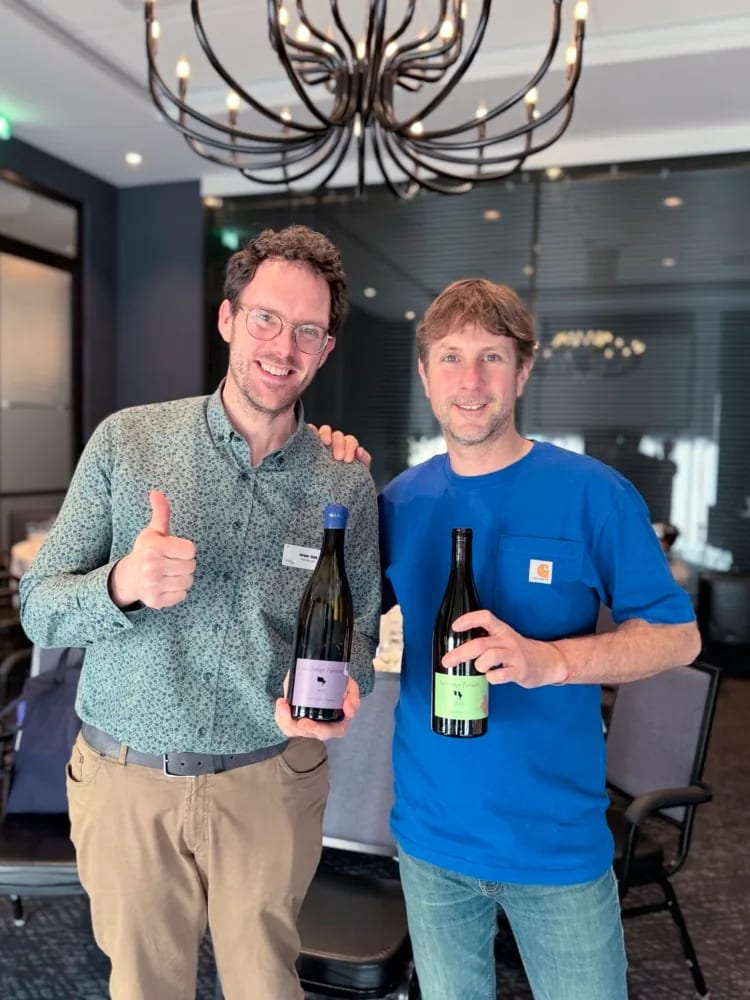
“Taste this,” said Damien Delecheneau, “then tell me what you think of sauvignon blanc.” The bottle was already open. A Quatre Mains 2022, one year in old large oak. The room went quiet on the first sip. Aromatic, full, round. Honey notes, a whisper of smoke, an unexpected salinity. Nobody had seen this coming from a Loire sauvignon.
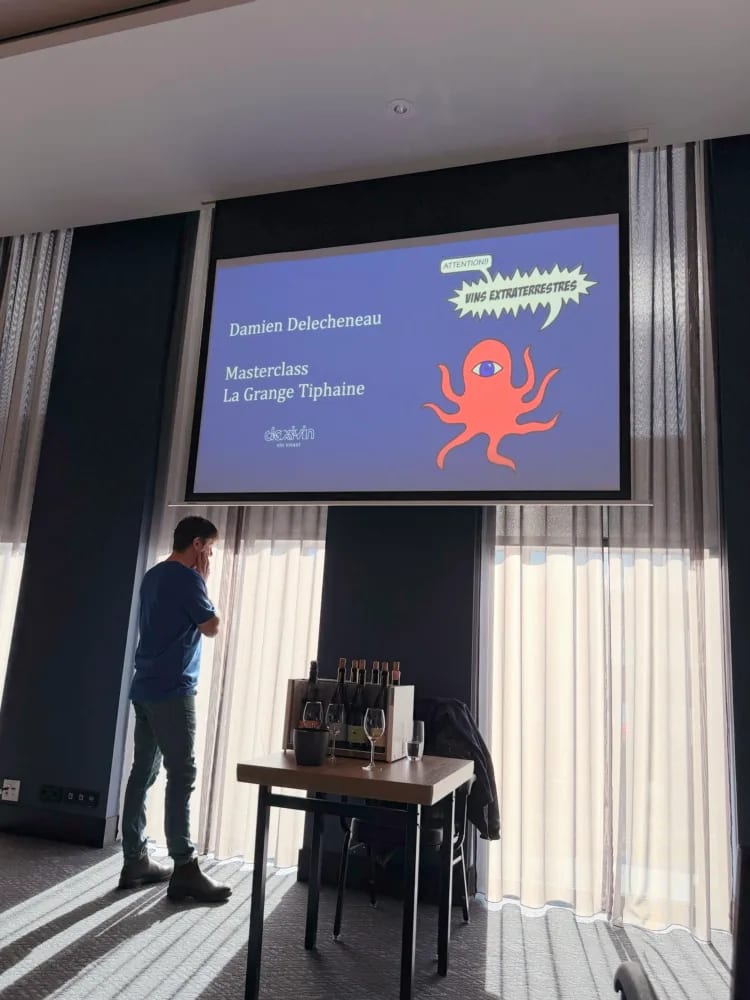
It was March 2nd, 2026, the Daxivin masterclass at ViniBio Amsterdam. Damien Delecheneau, owner of La Grange Tiphaine in Montlouis-sur-Loire, had brought twelve wines. Three hours earlier his flight from New York had landed. He apologised twice for being tired. Still this was one of the sharpest masterclasses I have attended in years.
The domaine
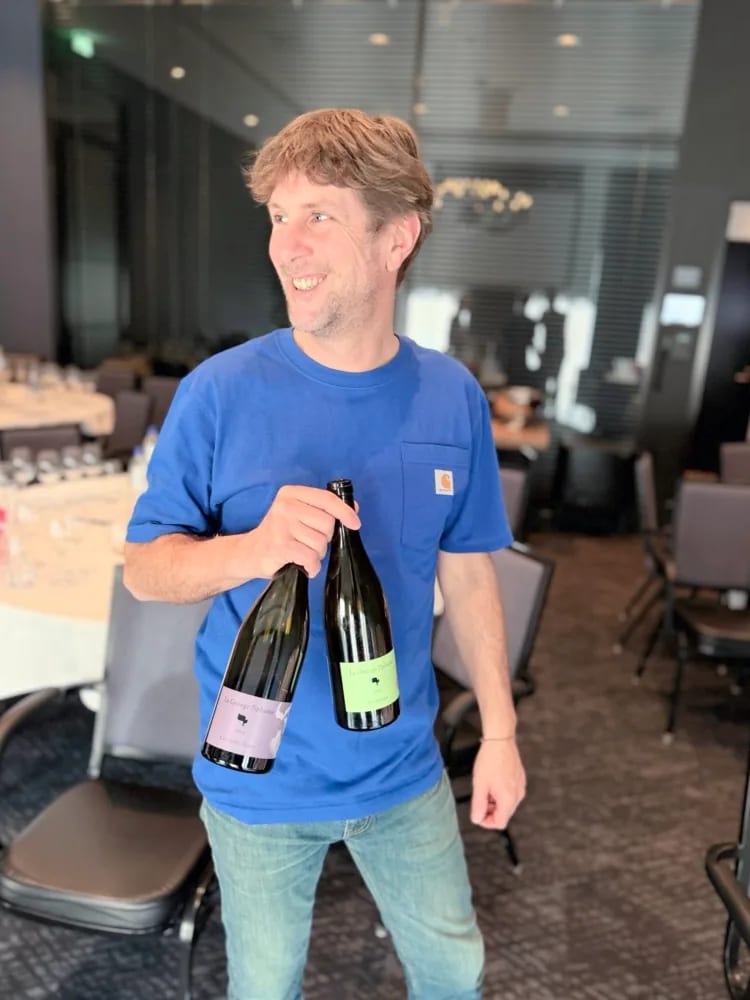
La Grange Tiphaine sits on the south bank of the Loire, in Montlouis-sur-Loire. Fifteen hectares, almost all chenin blanc, sauvignon blanc and Loire reds: cabernet franc, côt and gamay. Damien took over the family domaine in 2007. Coraline, his wife, joined as a full partner in 2009. They have run it together ever since.
The wines are all organic certified and biodynamic in practice. Spontaneous fermentation, no fining, no filtration. Minimal sulphur. The portfolio runs from dry still whites to late-harvest chenin, from light gamay to serious single-vineyard côt, and from classic méthode traditionnelle to official pétillant originel.
What stands out is the consistency. These are not natural wines with an excuse for the quirks. They are precise wines that happen to be minimally made. The difference sits in the vineyard.
From organic to biodynamic
Damien started organic in 2007. Three years later he switched to biodynamics. The reason was not ideological. “The organic style was not exactly the idea of making wine with healthy vines,” he explained. Organic work left the vines vulnerable through the transition period. He needed something deeper.
Soil health became his obsession. His definition of working soil stayed with me: a sponge. Something that can hold water and nutrients when the plant needs them, and release them at the right moment. “If you want good grapes, good bunches, they need to eat well. The soil needs to work.”
Since 2018 he has seen the result. The vines handle extreme vintages better than before. Heat, drought, climate swings. The alcohol does not spike unnaturally. The biodynamic preparations, the lunar calendar, the holistic view of the vineyard as an ecosystem: it all only works because the soil carries it.
The herbicide ban
Damien is president of AOC Montlouis-sur-Loire. In 2018, under his leadership, the herbicide ban went through for the entire appellation. One of the first regions in France to do it. No grower in Montlouis is allowed to use synthetic herbicides anymore, conventional or not.
That is not a small intervention. It costs growers time and money to weed by hand or machine rather than reach for a sprayer. The question was whether the region would hold.
Eight years later the answer is clear. Independent sources put organic certification across the appellation at around 35 percent — exceptionally high for a French AOC. Damien’s policy changed the structure of an entire appellation, not just his own domaine.
The chenin blancs
Chenin is what sets La Grange Tiphaine apart. Four expressions in ascending intensity showed the full range of the grape.
Clef de Sol blanc 2024 was the entry. Fresh, refined, full of energy. Pure grape, young vines, short ageing. The kind of wine where you stop talking and just taste. No makeup, no frills.
Les Épinays 2023 showed the strength of chenin. Aromatic, fruity, elegant. Soft texture, contained acidity, a faint sweet hint from ripe fruit without residual sugar. Here you see why top-level Montlouis chenin stays so underrated outside France. This is not Vouvray style, not Savennières style. It is its own profile.
Bécarre 2023 chenin from a selected parcel went deeper. More texture, more length, more movement. A wine that folds over the tongue rather than shooting across it. These are the chenins that will get more interesting in five years than they are now.
Buisson Viau 2020 closed it. A different direction: late harvest by passerillage, sun-drying on the vine without botrytis. About forty-five grams of residual sugar per litre. The wine does not taste sweet. It tastes concentrated. Honey, apple, pear, a light cream texture, with that pure chenin spine holding everything in tension. A dessert wine without the weight of many Sauternes styles.
The red wine revolution
I came for the whites. Loire reds are not usually my focus. But Damien’s reds were the surprise of the afternoon.
In 2021 he changed everything about his red wine vinification. Inspired by a trip to Sri Lanka, where he watched tea brewing, he reconsidered extraction from scratch. “Making maceration is like making tea,” he explained. “You don’t need to crush, to punch down, to extract everything. We understood that if we only extract 80% of the good things, that’s good. Because if you want to extract the rest, the 20%, you’re gonna extract a lot of bad things at the same time.”
The result? Cabernet franc, côt and gamay with purity, energy and elegance. No hard tannins, no over-extraction. The Bécarre 2023 cabernet franc showed red fruit, fine structure, enough acidity to carry weight. The Côt Vieilles Vignes 2019, from forty-year-old vines, was more imposing still. Dark fruit, fine tannins, clear cellaring potential.
Damien’s pride in this style was visible. Before 2021, he said, something was off in his reds. Now the balance arrives early.
That is an undervaluation in itself. Many Loire producers struggle with red. Damien has found a method that works for the region: gentle extraction, long maceration without forcing, early bottling. This is how Loire red can hold its own in the international wine world, alongside Burgundy pinot noir and Beaujolais.
Quatre Mains: the story behind the label
Back to the sauvignon that opened the masterclass. Quatre Mains is not a marketing concept. The name tells the story of the domaine itself.
Damien planted the vineyard in 2008. A specific parcel, higher elevation, with its own microclimate. Coraline joined as a full partner in 2009. “It was the first wine we made together,” he said. Quatre Mains. Four hands. Two people, one vineyard.
The wine carries that story. Not through pretension or romance, but through balance. A sauvignon blanc aged one year in old large oak. It could have gone banal: heavy, oaky, with no identity. Instead the grape got room without losing its character. Honey, soft smoke, an unexpected salinity from the oak ageing. Layered, contemplative, full without weight.
This is how you make sauvignon for people who think they do not like sauvignon.
The pétillant originel fight
The masterclass closed with two pét-nats. Wines Damien himself calls “probably the hardest thing I’m doing in the winery”.
He does not make cloudy, funky pét-nat. He makes clear, precise, terroir-driven sparkling wines via the méthode ancestrale. One fermentation, no added yeast, no dosage. What goes into the bottle stays in the bottle. “I try to show pét-nat as a real wine, with the real style of a still wine. The meaning of the vintage, the feeling of the grape, the vineyard, the appellation.”
The quality charter that gave pétillant originel official status within Montlouis was a collective fight by the appellation’s vignerons. It received legal status in 2007. Damien was deeply involved. “We struggled for 13 years, but we did it.” Montlouis was the first appellation in France to give pétillant originel a formal home. That is institutional change with implications for the entire natural scene. Pét-nat is leaving the niche and becoming a formal wine category.
The two pét-nats on the table showed where this is heading. One taut and mineral, with a focused mousse. The other more open, herbal, with more ageing notes. Both recognisable as pét-nat and as Montlouis. The kind of wine that will set the standard ten years from now for what pétillant originel can mean.
The verdict
La Grange Tiphaine is not an accessible domaine in the sense of a first bottle for anyone new to wine. It is a reference point for anyone wanting to explore biodynamic Loire seriously. Fifteen hectares, two generations, one clear philosophy, and wines that hold their own in every segment.
In the Netherlands the domaine is available through Daxivin. Marnix Rombaut had flown Damien in specifically for the masterclass. For an hour and a half he stood at the back of the room, nodding. It was no accident that the only masterclass at ViniBio 2026 was about Loire biodynamics.
For anyone wanting to explore chenin, cabernet franc and pétillant originel past the usual paths, this is the place to start.
Producer: La Grange Tiphaine, Montlouis-sur-Loire, Touraine Winemaker: Damien & Coraline Delecheneau Netherlands importer: Daxivin Website: lagrangetiphaine.com
Sources
- La Grange Tiphaine — Official site (Damien & Coraline Delecheneau)
- La Grange Tiphaine — Quatre Mains (sauvignon blanc)
- Jancis Robinson — Montlouis 35% organic + 2018 herbicide ban
- Vins de Montlouis — Le Pétillant Originel (2007 charter)
- The Wine Doctor — Montlouis Pétillant Originel
- Daxivin — About (Marnix Rombaut & Niels Huijbregts)
Tasted at the La Grange Tiphaine masterclass during ViniBio 2026, Hotel van der Valk Amsterdam, 2 March 2026. No partnership with Daxivin or La Grange Tiphaine.
More on Winemaker
Daxivin: Loire biodynamic wine importer
Daxivin brings Loire biodynamics to the Netherlands. La Grange Tiphaine, the pétillant originel charter, and Marnix and Niels' curation.
Read on →Cool Climate Wines: Beyond Bordeaux's Sustainability
What if everything we thought we knew about sustainable winemaking came from the wrong climate?
Read on →Fattoria Fibbiano Review: Tuscany's Indigenous Grape Heritage
While many Tuscan wineries chase Super Tuscan acclaim, Fattoria Fibbiano takes a traditional approach focused on indigenous grape varieties.
Read on →