

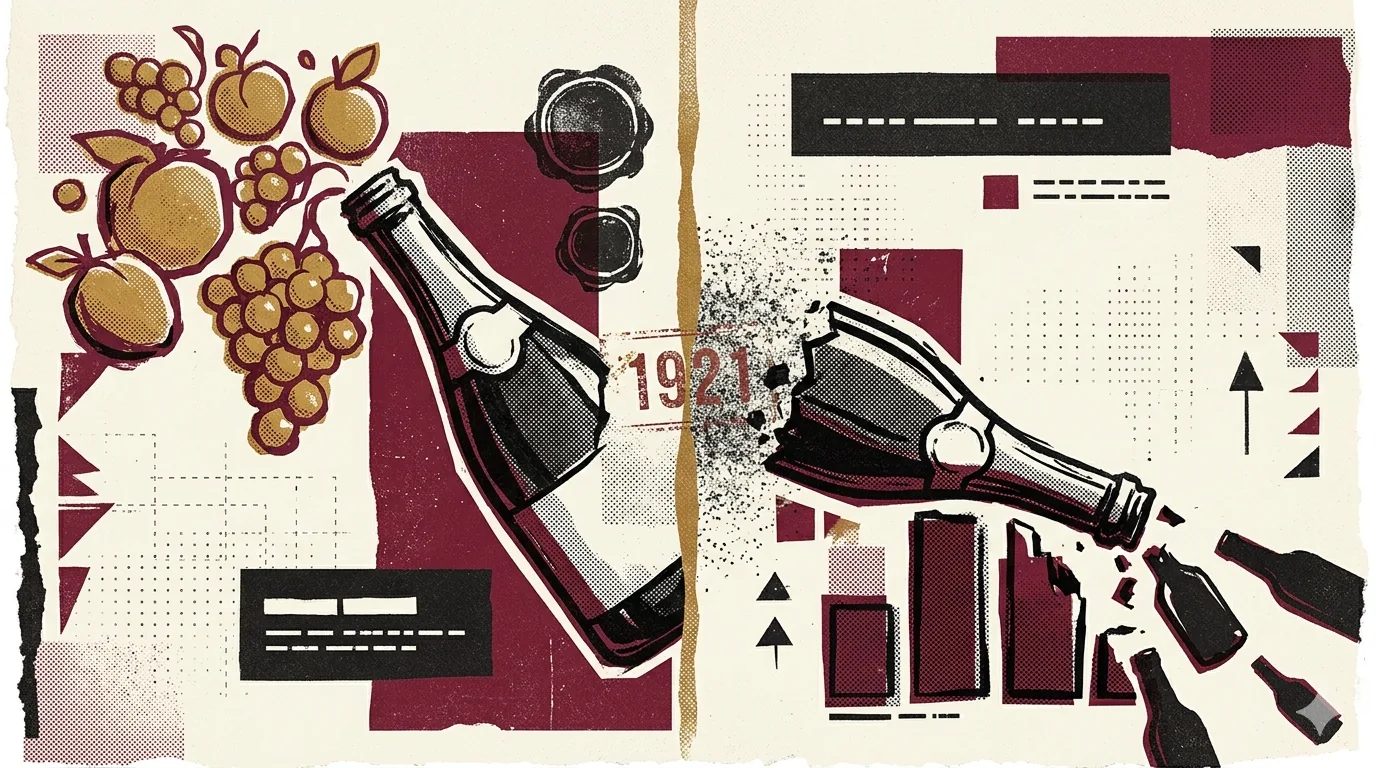
326 million bottles in 2022. 266 million in 2025. Minus sixty million in three years.
And in those same three years, Champagne harvested what producers describe as the finest vintage since 1990. Earliest official start date the appellation has ever seen (19 August, in Montgueux). Sugar levels the Comité Champagne called an ideal balance. Growers in Reims talking about a vintage of a generation.
Two numbers, one region. Not a contradiction — a choice.
The harvest no one predicted
July 2025 brought balanced rainfall. Early August delivered an intense heatwave. Sugar accumulation in the grapes climbed at 2.4 degrees potential alcohol per week — double the historical norm.
The Comité Champagne recommended minimum ripeness thresholds: ten percent for Meunier, 10.5 percent for Pinot Noir, and above eleven percent for Chardonnay. Most producers cleared those thresholds comfortably. Sébastien Dubuisson, technical director at the Comité Champagne, spoke in industry reports about a favourable balance between sugar and acidity across the three main grape varieties.
Hugo Drappier in the Aube started picking on 25 August — one of the earliest harvests in the estate’s history. Michel Drappier was surprised by the strength of Pinot Noir after the disastrous 2024 season.
Geographic variation did exist. Côte des Blancs and the eastern zones suffered cold weather during flowering. Smaller bunches, lower juice yield, especially Chardonnay. Côte des Bar and parts of Montagne de Reims, on the other hand, performed exceptionally. Pinot Noir came back strong.
And yet: 9,000 kilos per hectare
This is where the paradox becomes concrete. Despite this exceptional quality, the Comité Champagne capped the “rendement commercialisable” at 9,000 kilos per hectare. Second-lowest level in the modern era — only the 2020 Covid yield was lower at 8,000 kilos per hectare.
Not a technical necessity. A market decision.
Charles-Armand de Belenet, managing director of Bollinger, said it plainly in Drinks Business: “the Champagne market has entered a phase of correction and stabilisation”. His expectation: annual volumes will settle around 270 to 280 million bottles. Yields will likely stay in the 9,000 to 9,500 kg/ha band, barring a spectacular rebound.
Guillaume Roffiaen — Vines & Wines director at Terroirs & Vignerons de Champagne and cellar master at Nicolas Feuillatte — takes a different view: “the right balance for Champagne probably remains a target of 300m bottles per year”. For larger producers, the current cap is too tight. But the CIVC board is choosing stock balance over volume maximisation, deliberately.
The compensation mechanism: since 2023, growers can stockpile up to 10,000 kg/ha in their individual reserve, up from 8,000. A full vintage as buffer. That keeps pricing power intact during low-marketing-yield years.
The American rollercoaster
United States = largest export market. 26.4 million bottles in 2025. Lori Russo, director of the Bureau du Champagne USA, described the American market — despite economic and geopolitical headwinds — as a vital pillar for Champagne.
But what a headache that file became. In early April 2025 the Trump administration announced a 10 percent import tariff on most EU goods. On 7 August 2025 the rate rose to 15 percent, and on 21 August 2025 an EU-US framework confirmed the 15 percent tariff on most EU goods. The position of wine and spirits within that framework remained unresolved at the time.
Then on 20 February 2026 the US Supreme Court struck down the entire tariff regime. According to Wine Spectator.
Three regimes in eleven months. Importers held inventory bought under different duty rates. Distributors could no longer set a price list that held for more than a quarter. The WSWA, the American wholesalers’ association for wine and spirits, publicly opposed the tariffs — arguing they primarily hurt American businesses and consumers.
”The nature of celebration itself is evolving”
David Chatillon, co-president of the Comité Champagne, framed it in April 2026 without euphemism: the question is no longer just how much Champagne to produce, but what. The nature of celebration is changing.
In response, the Comité Champagne launched the 2040 Initiative. Goal: reposition Champagne as the symbol of celebration. The acknowledgement behind the campaign matters more than the campaign itself. Younger demographics, non-alcoholic alternatives, less ceremonial consumption — the official Champagne establishment has now conceded that this is structural, not cyclical.
That’s new. Until recently, declining sales were framed as inflation effects, post-Covid correction, geopolitics. Now official communications acknowledge that the culture itself is shifting.
What holds: price, not volume
Alongside Chatillon, Maxime Toubart represents the other side of Champagne’s governance structure — as president of the Syndicat Général des Vignerons, the union representing some 20,000 growers. The official message to the market remains consistent: value over volume, no price war.
That’s a deliberate choice. A commodity category facing this kind of volume drop would slide straight into a pricing spiral. Champagne avoids that because its luxury positioning holds and because the yield restriction keeps supply tight.
For the consumer it means: prices won’t fall. For small récoltant-manipulant growers selling direct to private clients, it means pain — less volume without structural pricing upside.
So what now
A vintage of a generation in the cellar, a market shrinking, an appellation deliberately throttling production to defend price. Three things that didn’t used to coexist.
The 2025 Champagne paradox is not a contradiction. It marks the moment when the region publicly acknowledged that quality and commercial growth have become two separate variables. Climate forces quality up. Culture forces demand down. The Comité Champagne chooses scarcity.
What 2025 produces in bottle reaches the market in two to three years. By then we’ll know whether the exceptional quality also bends the demand curve — or whether Champagne becomes a permanently smaller, pricier category.
One thing is certain: if you can reserve a Cuvée from this harvest in 2025, you should.
Sources
- CIVC 2025 shipment data: Comité Champagne — 2025 shipment review and outlook
- Peak volume 2022 (326M): Comité Champagne — 326 million bottles shipped 2022
- US shipments + Russo appointment: Wine Industry Advisor — US Champagne shipments reach 26.4 million bottles in 2025 · CIVC PR Lori Russo
- Yield cap + Belenet/Roffiaen quotes + reserve raise: The Drinks Business — Small but mighty (10/2025)
- 19 August harvest opening + EU-US tariff timeline: Le Monde — US tariffs cast a shadow over Champagne’s harvest
- EU-US 15% framework (21 August 2025): Fortune — Wine tariffs and EU-US framework
- SCOTUS strikes down tariffs (20 February 2026): Wine Spectator — Supreme Court strikes down Trump tariffs on imported wine
- 2040 Initiative + Chatillon position: The Drinks Business — Champagne puts celebration at heart of 2040 initiative (04/2026)
- Toubart as SGV president: Sommeliers Choice Awards — Maxime Toubart interview
- WSWA position on wine and spirits tariffs: WSWA — Tariffs on imported wine and spirits
⚠️ Fact-check required before publishing
This article was fact-checked on 2026-05-10. Critical FOUT-claims patched, unverified direct quotes rewritten as indirect speech. To re-verify before publication:
/fact-check-mdx champagne-paradox-2025Only set draft: false after a clean verdict table.
More on News

Argea's Habitat 2025: Italy's biggest private wine group runs a serious sustainability report. The pace is the question.
Italy's largest private wine group commits to 42% emissions cuts by 2030. The progress is real. The supply chain pact still covers only 60.5%.
Read on →
EU wine labelling 2026: what changes on Dutch wine shelves?
Since 18 March 2026, the bottle in front of you reads differently. Kcal symbol, QR code, alcohol-free or dealcoholized. What does Regulation 2026/471 mean?
Read on →
Wine Market Trends 2026: WMC, SVB & IWSR Data Analyzed
Wine market trends 2026 are more nuanced than the headlines suggest. Key findings from WMC, SVB and IWSR data, and what they mean in practice.
Read on →