

Lisbon airport, 2022, a two-hour delay. Jasper Smit of Halfes is on his way home from a wine trip in the Douro when he spots a plane from an airline he has never heard of, with a hawk painted on it. He is an aviation nerd, so he looks it up. The Portuguese word for hawk is açor. The airline flies out of the Azores, and the Azores, it turns out, make wine.
Two years later he is at a trade fair in Lisbon, can’t find the one producer he came for, and emails them to ask for samples. He pays for them himself. Today that wine sits in his warehouse. What happens between that plane and that pallet is the question behind this episode: what does a wine importer do all day?
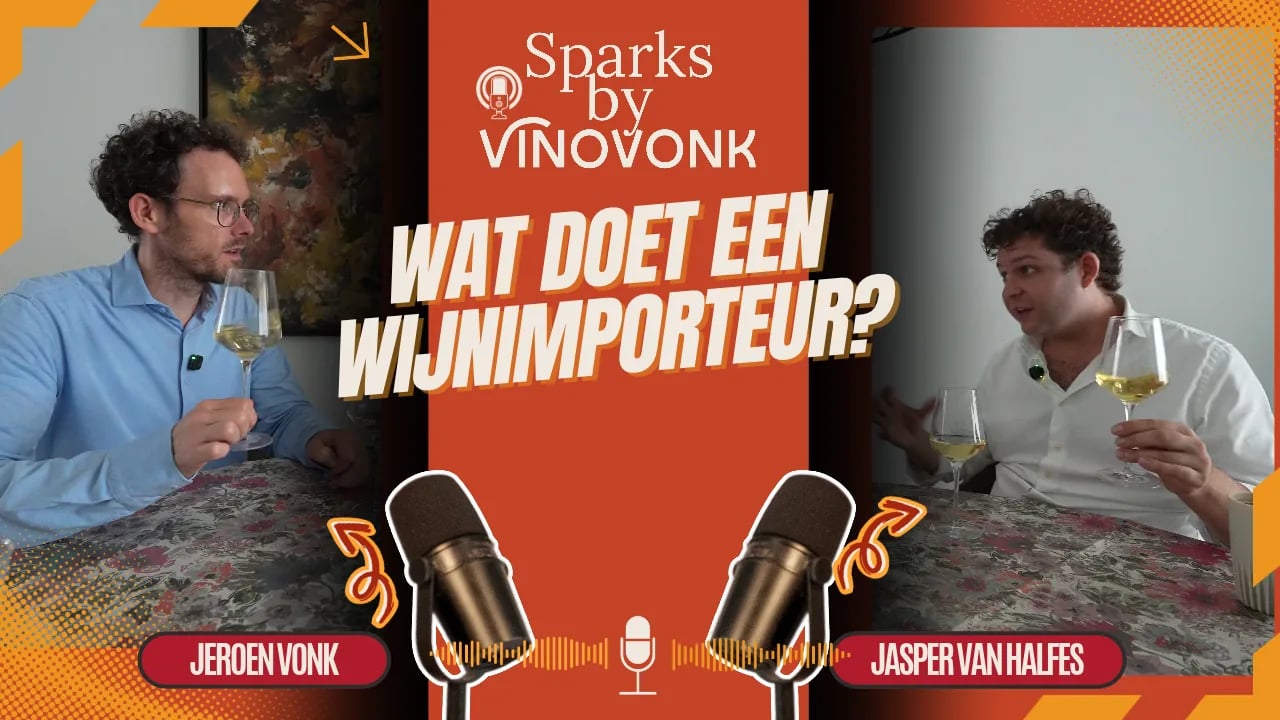
Jasper came over to my place with two bottles from Adega do Vulcão. He imports and sells both, which is worth keeping in mind when he talks about them. The conversation is in Dutch.
From student room to importer
From 1:01 in the video
It started on a café terrace, watching people drink wine from small bottles. The idea stuck. In the summer of 2018 he walked around ProWein, green as they come by his own account, talking to anyone who would talk back. He started importing alongside his studies and went full-time in 2020, the week before Covid hit.
He came up with the name on a bench in his student house. Halfes, from the Dutch for half bottle, one f short. Don’t ask him why.
The half bottles are a smaller part of the business than the name suggests. Roughly eighty percent of what he sells is now the standard 75 cl, twenty percent small, and most of the small ones end up in corporate Christmas hampers. Two people will order a full bottle anyway, he says, and a Coravin or a decent stopper keeps an open bottle going. There is a supply problem too: many growers can only bottle the standard size, and the ones who can do halves sometimes want you to take three or four thousand.
A volcano and an exodus
From 6:35 and 12:30
Adega do Vulcão was started by Italians who moved to the Azores because they fell for the place. They bought a house on Faial and were told that if they wanted to make wine, they should start on Pico too, the island where most Azorean wine is made. So it became a winery on two islands. Their vineyard on Faial is, according to Jasper, the westernmost in Europe.
It lies next to Capelinhos, the volcano that erupted in September 1957 and kept going for more than a year. Jasper tells how the eruption set off a wave of emigration to the United States, helped along by the then senator for Massachusetts, John F. Kennedy. Thousands of Azoreans left. It is a good story and I am passing it on as he told it; I haven’t checked the numbers.
Tasting: Ameixâmbar 2023
From 15:05
The first bottle is Ameixâmbar 2023, a field blend of Arinto dos Açores, Verdelho and Terrantês do Pico from Faial and Pico. The name comes from an Azorean fairy tale about a whale that swallowed a plum, which is how the islands were supposedly born. The nose struck me as aromatic but stern, as if you could smell the acidity. On the palate it is fully ripe, with acidity in several layers and a salty streak. Jasper’s advice is not to serve it too cold, and to decant it if you can.
What should a special bottle cost?
From 16:27
Jasper is upfront that this is not a cheap wine. Twice a year he asks people around him what they spend on wine in restaurants, wine shops and supermarkets. For many of them, twenty euros a bottle is the ceiling. This one sits well above it.
I think the price holds up. On Pico the vines grow in currais: plots of a few square metres walled in with lava stone, one or two plants in each. Everything is done by hand. It reminds me of Santorini, where they weave the vines into low baskets against the wind. Here the stones do that job.
Where do new wines come from?
From 25:41
Jasper gets four or five cold emails a day from producers who want him to taste their wine. Most of them go nowhere. Italy is out altogether; he doesn’t do Italian wine. His main source is trade fairs, ideally in the country itself: Greece, Portugal, France. He also joins buying trips run by the Netherlands Enterprise Agency (RVO) or by wine regions, and sometimes he approaches a producer directly, as he did with Adega do Vulcão.
At a two- or three-day fair he tries to meet about a hundred growers. Only a few become suppliers; his own estimate is around five percent.
His filter is strict. If you don’t speak English, he won’t work with you, because he wants to bring you to the Netherlands one day and see how you handle a room. Since 2024, anything new he takes on has to be organic or converting. Even that rule has grey areas: the two Adega do Vulcão wines are not certified organic. They carry an Azorean certification that Jasper calls comparable to organic, but not one hundred percent. He keeps a spreadsheet of what he is looking for, by region and price band. And he checks what a producer paid to exhibit: if the stand was free, a winery might send a niece who knows little about the wine.
Comparing prices across borders
From 30:32
I asked whether a local wine list tells you what a wine ought to cost. Jasper thinks it misleads. In Portugal a restaurant might double the cost price, in France triple it, in the Netherlands multiply it by five. Duty, transport and tipping all differ. He would rather see what a wine sells for in Norway or the UK, and whether Dutch drinkers can currently only buy it abroad. If they can, that is an opening for him.
Tasting: Capelinhos 2024
From 33:45
The second bottle is Faial only, from the vineyard by the volcano. Paler, younger and fresher than the Ameixâmbar. Jasper calls it the more gastronomic of the two. I found it full and rich, lots of fruit, spicy, and that salinity again in layers, like a walk along the shore. Jasper wants oysters with it, nothing on them, or mussels.
Faial cannot appear on the label: the island is not yet a recognised wine area in its own right, and the wine is made on Pico. The label says IG Açores.
Bottle or glass
From 37:54
Someone once told me he orders by the glass in restaurants because an eighty-euro bottle feels steep. Jasper runs the numbers the other way: nine times out of ten the bottle is far better value. He runs them for the restaurant too. A cheap house wine earns less per bottle than an expensive bottle marked up only twice, and the expensive bottle is less work: one order, fewer trips to the table, fewer glasses to wash.
I do something similar when I read a list. I check what they charge for a bottle of Krug and compare it with the shop price. That tells you roughly how much the place adds on top.
Jasper thinks restaurants could charge more, as long as service comes with it. On one of the hottest days of the summer he visited four places and was offered free water in one of them. We spend a few minutes on water as a service rather than a line on the bill before I steer us back to wine.
Organic, sustainability and bottle weight
From 54:15
I had my doubts here. Jasper prefers heavier bottles. Thin glass breaks more often, and a case with one broken bottle leaves him eleven bottles with stained labels he can’t sell at full price. He considers that less sustainable than a somewhat heavier bottle. He admits he hasn’t done the maths. He is going on what he sees in his warehouse, and I would like to see someone run the numbers.
The new warehouse, and from sample to pallet
From 56:39 and 1:03:38
Jasper recently moved into a warehouse about twice the size of the old one. For someone who wants as little stock as possible, that sounds odd, and I told him so. He plans to add four wineries soon, and the more you buy in one go, the lower the freight cost per bottle. Of the twelve thousand-odd bottles that moved with him, twelve broke.
From first sample to first sale takes at least a year. A wine has to fit the range, the warehouse and the budget, because a pallet means thousands of euros paid up front. With a new grower he starts with half a pallet to see if it sells. A tasting panel of enthusiasts, trade people and sometimes a sommelier gets a say, and he visits the estate before he signs anything.
Groningen outsells Utrecht
From 1:14:10 and 1:18:57
Jasper wants to be a creative supplier of Portuguese and Greek wine, with Portugal first. He wants more half bottles, more of his own events, and winemaker dinners only if the wine stays on the list afterwards. Most of his bottles go to Groningen, in the north, where he visits customers about once a month. In Utrecht, his home base, he sells almost nothing.
The future of wine
From 1:21:05
My bet is that we’ll drink more wine from cooler climates, and that the Netherlands will turn out to have good soils for it. Jasper sees people reading and learning far more about wine since the pandemic. He wants labels in plain language that say how long the wine spent in oak and what happened in the cellar. A technical sheet only a chemist can follow does nothing for the average drinker.
Listen and watch
YouTube: youtu.be/89Gq_YZ_AMk Jasper’s wines: halfes.nl
Subscribe to the In het Glas newsletter to hear first when the next Sparks episode goes live.
Previous episode: Montse Molina on organic sherry. All episodes: Sparks.
Watch