

For this episode of Sparks I travelled to Santorini without leaving my chair. On the other end of the line was Stella Papadimitriou, winemaker at Artemis Karamolegos in the village of Exo Gonia. She had just brought in the 2025 harvest, so the conversation started exactly where it should: in the vineyard.
It all started with one bottle. The Ftelos 2021, a single vineyard from this estate, made the Great Greek Wines list of Master of Wine Yiannis Karakasis. He told me plainly: you have to taste this. The bottles arrived through Oenopolis, the Dutch importer. Four wines, all Assyrtiko, and yet four completely different stories.
A small family estate that is not so small anymore
Artemis Karamolegos made his first wine in 2003, driven by his love for the island and the legacy of his grandfather. It is still a family business with a handful of permanent staff, around five people, and yet production runs toward 15,000 bottles in an average year. Small on paper, serious in practice. About ninety percent is Assyrtiko; the rest includes Mavrotragano, the island’s rare red grape.
Stella joined in 2021, after harvests in New Zealand and Australia and an oenology degree in Greece. Why Santorini? “I wanted to learn what this extreme terroir does.” The extreme part is not marketing. On Santorini the wine grows in about the hardest conditions you can imagine.
Kouloura: baskets against the wind
Look at these vineyards and you will not immediately recognise them as vineyards. The vines crawl across the ground, coiled into a basket. That kouloura is not folklore but an answer to the hard wind that sweeps the island in winter and early spring. The grapes grow inside the coil, sheltered from wind and sunburn, in the shade of their own leaves.
The soil is volcanic and much the same across the island. They call it aspa in Greek, a light soil of pumice from the eruption, ninety to ninety-five percent sand. It barely holds water, but it does catch the winter damp and the summer fog, just enough to cool the parched vines. Everything is done by hand. Sometimes you cannot even reach a vineyard with a vehicle and you carry the basket of grapes all the way back to the car.
Then there is the age. Most Assyrtiko vines are between 80 and 150 years old, ungrafted, on their own roots. The name of their top wine, 34, points to the thirty-four centuries that wine has been made on Santorini. You do not taste a young project. You taste a long line.
2025: a reckoning in the vineyard
The last few years were dry, and 2025 took the crown. Winter brought about 165 millimetres of rain, followed by strong wind again. The yield sits roughly fifteen percent below 2024, and 2024 was already well below 2023. Stella is not gloomy about it. The fog in the final ripening stage helped, the alcohol is lower than usual, and the balance with the acidity is actually lovely. “Aromatically the wine sits on the same line as last year. Only the alcohol is lower.” She calls 2025 a year of realisation: as a producer you now know you have to act on the vineyard, because this kind of drought is the new normal.
Why so many wines from one grape
Karamolegos makes an impressive range: the fruity Terra Nera line, the classics Santorini Kouloura, Nykteri and Vinsanto, the fine selection with 34 and Pyritis, the island’s first skin-contact Assyrtiko (Mystirio), and four single vineyards. That is deliberate. They vinify every vineyard separately, in small tanks, and only at the blending in April and May do they decide which lot becomes which label.
I put it to Stella that this makes life needlessly complicated. Why not one generic wine and a few single vineyards? Her answer was clear: split the same must across three tanks and you get three different wines, even when you do exactly the same thing everywhere. That complexity is not a by-product, it is the point. More layers in the glass means more work in the cellar. At this estate, less really is more.
The tasting
Santorini (Kouloura) 2020. A colour that sits right between too pale and too deep. On the nose, butter straight away, some saline notes and a touch of bitterness, complex yet approachable. On the palate it is fresh, with acidity that is clearly there without shouting, juicy fruit and fine balance without a big body. A wine you can drink in one go without it begging for food. Honestly, in its 2020 form it is still young. Stella admitted as much herself. Reckon on three to five years from the harvest before an Assyrtiko is at its best. Since 2023 this wine is called Santorini Kouloura, a nod to the basket system.
34, 2022. Named after those thirty-four centuries. Eighty percent stainless steel, twenty percent fermented and aged in cement and clay pots, with a whisper of oak. Rounder on the nose than the first, with different layers of acidity and salt and a roundness the first one did not have. A step up, with clearly more ageing potential. Think of a good Riesling: a white that gets better with the years rather than worse.
Pyritis 2022. A cuvée of three old-vine parcels from Pyrgos and Megalochori, the best vinifications of each year, with around twenty percent oak. The colour is a deeper yellow, the nose creamier, with butterscotch and tropical notes of peach, pineapple and coconut. And here comes the critical note: that creamy, oak-led style makes the wine seductive, but it also makes you wonder for a moment whether this is still real Assyrtiko. Stella owns it without dodging. Take a sip and the answer arrives on its own: the acidity cuts straight through, as if the grape is saying do not forget me. She expects the oak to integrate further within one to two years. If you want the pure, crystalline style, pick an older vintage or a different bottle. If you love this texture, you are in the right place.
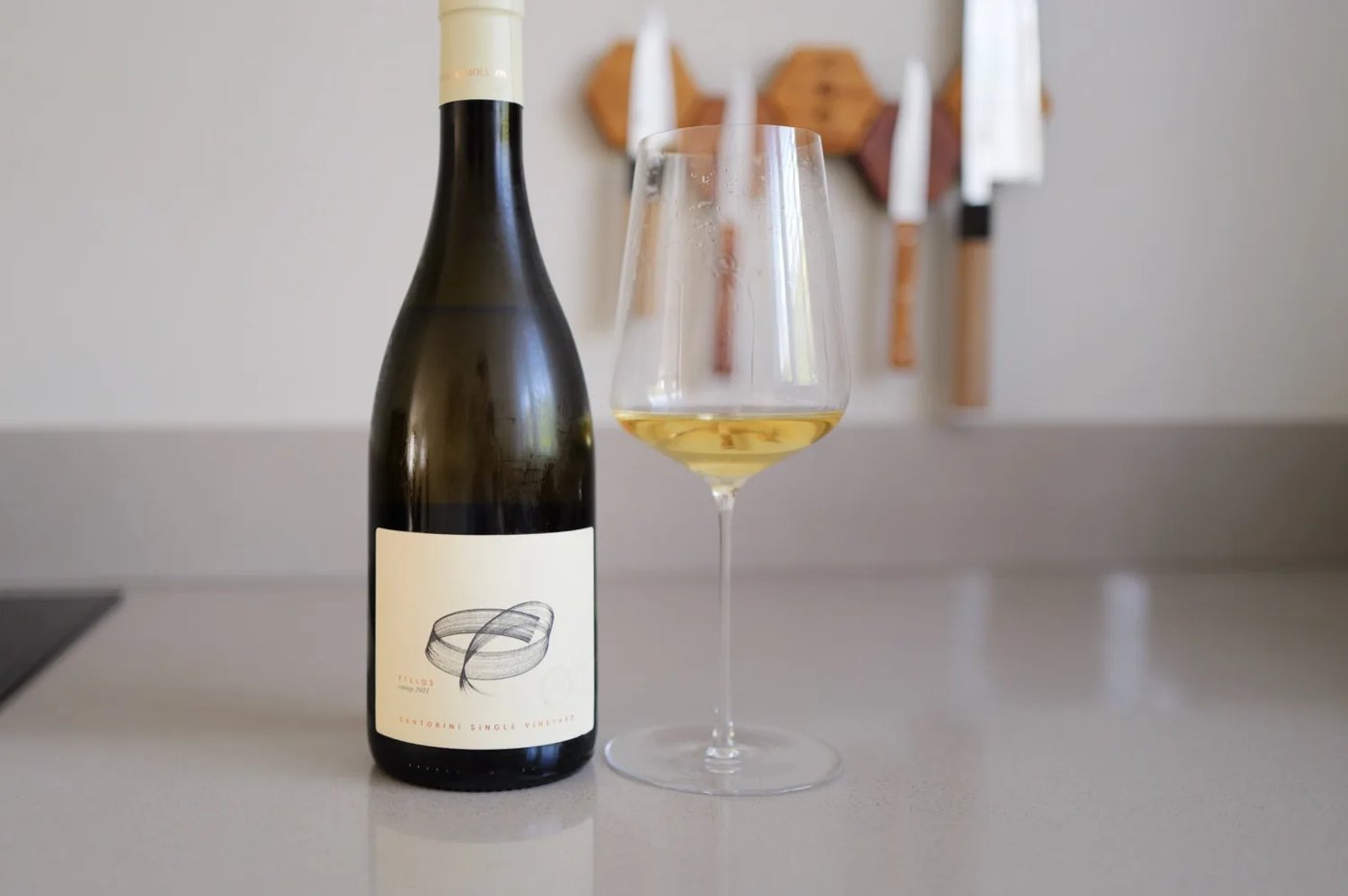
Ftelos 2021. The reason I called. A single vineyard close to Fira, facing the caldera, with vines around 150 years old. The same vinification as the other single vineyards, so the site itself does the talking. Four years old and you can tell. The nose is fresh and complex at once, with grapefruit peel and a fine bitterness, floral hints, hazelnut and walnut, dried fruit alongside fresh fruit. Pure, clear, and on another level from the rest. This is not just a tasty Assyrtiko, it is a complete story. I fully understand why it sits on the Great Greek Wines list.
The most interesting part of the day
Four wines from one grape, and yet four aroma spectra of their own, while the Assyrtiko identity holds throughout. That is the clever bit. Karamolegos experiments with micro-vinifications, keeps what works apart and dares to build a new wine from it. There is a real risk that a range this large confuses the average buyer more than it tempts them, and the single vineyards sit firmly at the top end with prices around 80 to 100 euros. But take your time and you taste a house that does not chase the easy option, it chases the interesting one.
Watch along
Taste it yourself
The wines of Artemis Karamolegos are available in the Netherlands, Belgium and Germany through Oenopolis. If you want to visit the estate, Stella will welcome you with open arms at the vineyard and the restaurant Aroma Avlis in Exo Gonia. Yamas.
Oenopolis supplied the bottles for this tasting. I received no payment for it and the opinions are entirely my own.
Frequently asked questions
What is Assyrtiko? Assyrtiko is the main white grape of Santorini, known for high fresh acidity, minerality and a saline edge. It can produce both taut, racy wines and richer, oak-aged styles.
What does kouloura mean? Kouloura is the traditional basket-training system where the vine is woven low to the ground into a coil. The grapes grow inside it, sheltered from Santorini’s hard wind and fierce sun.
Why is the wine called 34? The name points to the thirty-four centuries that wine has been made on Santorini.
Where can I buy the wines of Artemis Karamolegos? In the Netherlands, Belgium and Germany through importer Oenopolis.
Transcript
The full conversation transcript.
Show full transcript
This transcript is generated automatically from the audio and has not been edited. Speech recognition makes mistakes, so treat wording as an approximation rather than a verbatim quote. It is here for accessibility and search.
Jeroen Vonk: Hi and welcome to a new episode of Sparks by VinoVonk. My name is Jeroen and I’m guiding you through the world of wine, spirits and other innovative drinks. And today we’re going to Santorini. And I’m not going to do it alone.
Jeroen Vonk: I’m doing that with the winemaker, Stella Papadimitriou.
Jeroen Vonk: Okay, Kalimera Stella, how are you doing?
Styliani Papadimitriou: I’m really fine because we just finished the harvest because a week, two weeks before and we are really…
Styliani Papadimitriou: So we can share some of our results for the Vintage 2025.
Jeroen Vonk: Oh,
Jeroen Vonk: that’s perfect because you’re based in Santorini and I got in contact with you because of the recognition of this wine, the Ftelos 2021 is in the Great Greek Wines.
Jeroen Vonk: I talked to Yiannis Karakasis about it and he told me, you have to taste it. So thanks to the sponsor of the show, Oenopolis from the Netherlands, your wine importer, he sent me these great bottles to taste together. Thanks again to Oenopolis for sending me these bottles. So you are in Santorini and you are in Exo Gonia. And where is that on the island?
Styliani Papadimitriou: It’s in the middle of the island.
Styliani Papadimitriou: The winery and the restaurant is located in Exo Gonia. Our vineyards are mostly in the highest altitude of the island, so mostly in the two villages of Pyrgos and Megalochori.
Styliani Papadimitriou: some vineyards mostly of Mavrotragano next to the winery but our vineyards are located in the
Jeroen Vonk: Yeah, and you only make wine from your own vineyards.
Styliani Papadimitriou: So we have some producers that we have the cooperation for many years and we buy from them the grapes and we…
Jeroen Vonk: Yeah, because.
Jeroen Vonk: Because I understand that maintenance on the vineyards is very different from in Santorini than other countries because you don’t have the Gobelette or the Gio system. You have a totally other system because you have a very hard wind. Could you tell us something about how the vineyards look?
Styliani Papadimitriou: It’s hard to recognize sometimes the vineyards. are…
Styliani Papadimitriou: close to the ground and this is a traditional style of pruning because of the strong winds during the winter and during the early spring we have really strong winds and we have to protect the caves from this
Styliani Papadimitriou: and also this kind of basket protects the grapes from the sunburns because the grapes grow inside the basket and the leaves shade the vines and the grapes and this protects from the sunburns so we can keep good maturing
Styliani Papadimitriou: so we still reach around 14 degrees of potential alcohol.
Jeroen Vonk: Wow. Could you tell me something about the soils and the terroir of the vineyards and of Santorini?
Styliani Papadimitriou: Santorini is a volcanic island and the soil all over the island are almost the same. it is called aspa in Greek and this is pumice from the eruption.
Styliani Papadimitriou: you see even if you go to the
Styliani Papadimitriou: see the many different
Styliani Papadimitriou: So this can, in this kind of soils we have no…
Styliani Papadimitriou: is something like 90-95 % of sand.
Styliani Papadimitriou: But this kind of soil can keep some of the humidity during winter and some of the fog during summer in order to refresh the super dry vines.
Jeroen Vonk: That’s very interesting.
Jeroen Vonk: So in the baskets, how many baskets of vines are there in like one hectare? Or can’t you say it in one hectare?
Styliani Papadimitriou: So we have a different measurement but in one hectare it is about 3,000 vines in a hectare. But in some really old vines because they are not in a row so you can find something like 2,000 vines per hectare.
Jeroen Vonk: Yeah.
Jeroen Vonk: You have to do everything by hand because you can’t use machines. Maybe you can get a machine to go to the vineyard and that’s it.
Styliani Papadimitriou: Sometimes
Styliani Papadimitriou: you can’t approach a vineyard, so sometimes you have to carry the basket with the grapes by hand.
Styliani Papadimitriou: to find the car.
Jeroen Vonk: Yeah, it’s very difficult. And could you tell something about the winery?
Styliani Papadimitriou: the wire.
Styliani Papadimitriou: began the production in 2003 by Artemis Karamolegos.
Styliani Papadimitriou: especially in the wine because of his grandfather. He was also produced…
Styliani Papadimitriou: decided to start this business on his own. So we are talking about the small and family business.
Styliani Papadimitriou: but we still remain in a farm.
Styliani Papadimitriou: and his wife.
Jeroen Vonk: But a family business isn’t a small business because you produce like 15,000 bottles a year.
Styliani Papadimitriou: Yes.
Jeroen Vonk: But that’s not very small.
Styliani Papadimitriou: two years
Styliani Papadimitriou: not the last two years but yes this is the average
Styliani Papadimitriou: and Artemis Karamolegos is a winemaker.
Styliani Papadimitriou: He has really passion for experimentation.
Styliani Papadimitriou: and Santorini also, it’s his homeland.
Styliani Papadimitriou: So he really loves vineyards and Santorini is wild.
Jeroen Vonk: Yeah, and what kind of grapes do you grow? Is it only Assyrtiko or also other kinds of grapes?
Styliani Papadimitriou: that Assyrtiko is about 90 % of the total production.
Styliani Papadimitriou: Monday.
Styliani Papadimitriou: of the total production, which is also a red-gray that…
Styliani Papadimitriou: produce a wine from…
Styliani Papadimitriou: it is mostly new planted vineyards.
Styliani Papadimitriou: salt and for this kind of wine it’s only from
Jeroen Vonk: And the other venues of Assyrtiko, are they all 20 years old or are they older?
Styliani Papadimitriou: also planted some Vincat’s and now they are…
Styliani Papadimitriou: 8 to 10 years old, but mostly the Assyrtiko vineyards are 80 to 120 to 150 years old.
Jeroen Vonk: that’s very old. So you don’t have…
Styliani Papadimitriou: And that’s why they are
Styliani Papadimitriou: suffering the last two years because of the super dry conditions. They are really old vines and they need…
Jeroen Vonk: Yeah.
Jeroen Vonk: Yeah, and because the last two years the conditions were very dry, and how in terms of yield or in terms of production, how much bottles less did you make?
Styliani Papadimitriou: Less.
Jeroen Vonk: Yeah, normally it’s 15,000 average.
Styliani Papadimitriou: We can say that the vintage 2025 is about 15 % less than 2024, which was also really low.
Jeroen Vonk: So 2025 is 15 % lower than 2024, but 2024 was even lower than 2023.
Styliani Papadimitriou: like
Styliani Papadimitriou: 20 or 30 in some cases less than 2023.
Jeroen Vonk: So it’s very small, the conditions are dry. how does it show you less quantity? But how do you think about the quality? Because it’s not only the quantity that counts, it’s also the quality.
Styliani Papadimitriou: day so
Styliani Papadimitriou: say that the 25 was vintage a year of realization because the producers understand that if we don’t do something with the vineyards
Styliani Papadimitriou: So the growing season has a winter with very low rainfall, something about 165 millimeters.
Styliani Papadimitriou: during the growth period we had again strong winds and
Styliani Papadimitriou: This is this effect the
Styliani Papadimitriou: a big part of the vineyard also in the final stages of the maturation.
Styliani Papadimitriou: We have.
Styliani Papadimitriou: Instead of other years we have some humidity from the fog.
Styliani Papadimitriou: this helps to help the ripening of
Styliani Papadimitriou: of this vintage, it’s a different expression of the versatile acidity because we have less alcohol than other years but a really good balance with the acidity.
Styliani Papadimitriou: This is something that…
Styliani Papadimitriou: view but our wine remained distinctive and
Styliani Papadimitriou: even with these conditions.
Jeroen Vonk: Yeah, so in one side you have bad news, but on the other side you have very good news because the alcohol is lower, the acidity, the balance with acidity is better and yeah, it’s outstanding premium wine still.
Styliani Papadimitriou: and we still keep
Styliani Papadimitriou: the typicity of the variety. So aromatically it’s in the same way as the previous year. The only thing that changed is this lower.
Jeroen Vonk: No, and I have here four different kinds of wines, but how many wines do you produce? How many sorts of wines?
Styliani Papadimitriou: we produce white wine.
Styliani Papadimitriou: series that we are called Terra Nera and it’s one Assyrtiko, one rosé from Mandilaria and Assyrtiko and one red from Mandilaria.
Styliani Papadimitriou: series which is Santorini, Nykteri and Vinsanto. Then we have the fine selection which is a parted from 34 Assyrtiko piripis.
Styliani Papadimitriou: And we have our single vineyards, four different special vineyards from all over the island that we selected from the years that we realized that have something special to say.
Styliani Papadimitriou: Also the Mystirio which is a skin-contact Assyrtiko, we are the first winery that produce skin-contact Assyrtiko. We also have our Mavrotragano, the red.
Jeroen Vonk: That’s a lot. And you are the winemaker together with the owner. But how many people do you work with?
Styliani Papadimitriou: In the…
Jeroen Vonk: Five people.
Styliani Papadimitriou: sailor door but during
Styliani Papadimitriou: As a permanent position we are about five.
Jeroen Vonk: Yeah, and what is your specialty as a winemaker?
Styliani Papadimitriou: was studying at first to a cultural tourist.
Styliani Papadimitriou: also studied oenology in Greece.
Styliani Papadimitriou: centering since 2017.
Styliani Papadimitriou: just traveled for two years in New Zealand and Australia for the Vintages and then I’ve been back to Santorini in Artemis Karamolegos Winery. I am since 2021.
Jeroen Vonk: So it’s a big journey, but why did you want to work in Santorini?
Styliani Papadimitriou: Santorini is really well known.
Styliani Papadimitriou: So I want to learn what they do, what is this extreme terroir, what kind of vineyards are they?
Styliani Papadimitriou: Yes, as a winemaker I can say that we don’t do much in vinification in the winemaking. We just leave the vines to express themselves. We really respect the grapes and that’s why we have so many expressions of the same variety because we really believe that Assyrtiko is a multi-dynamic
Styliani Papadimitriou: grape, we can produce super high acidity wines, super sweet dessert wines, more fresh wines and fruity, more mineral wines with the same fruit.
Jeroen Vonk: Yeah, it’s very diverse.
Styliani Papadimitriou: Less is more!
Jeroen Vonk: Yeah, let us more. So in terms of vinification, if we are going to taste the wines, all the answers are the same. Just leave to let it rest and let it do the same thing. Or do you do something with other kinds of cold maceration in other temperatures, the vinification?
Styliani Papadimitriou: in the press because we truly believe that the Assyrtiko is a phenolic grape and we also believe in the aromas of the skins of the Assyrtiko. Assyrtiko is not so well known as an aromatic variety.
Styliani Papadimitriou: things to take from the skins except for aromas. So yes, almost all our wines we do…
Styliani Papadimitriou: consideration.
Jeroen Vonk: Yeah, and do you finify it at the same temperature or does it vary?
Styliani Papadimitriou: from the wines that we will taste, yes, they are almost everything in the same temperature. For example,
Styliani Papadimitriou: in aromas so we keep lower temperatures but for the Assyrtikos that we are we want to keep the typicity and the
Styliani Papadimitriou: in higher.
Jeroen Vonk: And what kind of yeast do you use?
Styliani Papadimitriou: So if someone visits the wine…
Styliani Papadimitriou: 80 vessels, Inox vessels,
Styliani Papadimitriou: So we do.
Styliani Papadimitriou: We do some experiments with the…
Styliani Papadimitriou: yeast while fermentation but we also use some selected yeast.
Styliani Papadimitriou: same way of vinification.
Styliani Papadimitriou: we select which tank it’s going to be for the hippies or for 34 after 6 to 7 months of maturation and we have many tools to work
Styliani Papadimitriou: options with this way.
Jeroen Vonk: That is a choice to make it complicated for yourself. Because you could also think, okay, let’s make one general wine and like three single vineyard wines. And if the single vineyard wines aren’t as good as we think, okay, then we put it in a generic wines, then it’s much simpler. Why do you add so much complexity?
Styliani Papadimitriou: Even if it’s…
Styliani Papadimitriou: even in the
Styliani Papadimitriou: small vessels because of the complexity. you share the same juice in three different tanks you will find
Styliani Papadimitriou: even if you follow the same way of vinification. Just because we don’t know. So then at the…
Jeroen Vonk: It’s different.
Styliani Papadimitriou: I’m
Styliani Papadimitriou: the result that we want every time for every label.
Jeroen Vonk: So you do it for adding complexity in the flavors and to add complexity, have to also add complexity to your vinification and all your work. Otherwise you can’t get the complexity in your wines. Yeah. Shall we start? Yeah.
Styliani Papadimitriou: If you think that… yeah…
Styliani Papadimitriou: we can start.
Jeroen Vonk: Shall we start tasting some wines? I’m very curious now. And which one do you want to start?
Styliani Papadimitriou: from this board that we have in front of us.
Jeroen Vonk: This one.
Styliani Papadimitriou: Yes, we have the same vintage so it’s Santorini from the Vintage 2020.
Jeroen Vonk: Yes.
Jeroen Vonk: It’s a very clean label and does all the dots mean that it comes from different vineyards?
Styliani Papadimitriou: This is a really good time to say that we did a rebranding for the Vintage 2023. So Santorini, now you will find it as Santorini Kouloura.
Jeroen Vonk: Okay.
Styliani Papadimitriou: This is the new Santorini.
Jeroen Vonk: Okay.
Styliani Papadimitriou: And this is exactly what we said before.
Jeroen Vonk: Yeah.
Jeroen Vonk: I like the color because it’s not too dark, it’s not too light. And when you swirl and you take a sniff, you immediately have lots of food, but also lots of complexity. Some butter notes, some salinity, some bitter notes. It’s very complex, but at the same time, it’s very accessible and very attractive.
Jeroen Vonk: And what is the goal for this wine? What do you want to achieve with this wine?
Styliani Papadimitriou: see.
Styliani Papadimitriou: Are you done?
Styliani Papadimitriou: that it’s more expressive aromatically instead of the following.
Styliani Papadimitriou: vineyards from all over the island.
Styliani Papadimitriou: the vinification takes part in stainless steel tags.
Styliani Papadimitriou: Express.
Styliani Papadimitriou: the classic intense minerality.
Styliani Papadimitriou: expensive wine than the others and this is the first wine that we release from every vintage.
Styliani Papadimitriou: first bottle from Evrivint is Santorini.
Jeroen Vonk: And the other wines have more bottle maturation before releasing.
Styliani Papadimitriou: Exactly Santorini also has a long time of maturation. It is about…
Styliani Papadimitriou: in the stainless steel dark but after the bottling session we released after three months in the bottle instead of the others that for example
Styliani Papadimitriou: six months.
Styliani Papadimitriou: in the vineyards as the tailors that we are.
Styliani Papadimitriou: at 6 months in the bottle and then after we taste the wine we decide if we release or not.
Jeroen Vonk: So, okay, I will have that question when we’re going to taste that. Shall we taste this one? Yamas?
Jeroen Vonk: It’s very refreshing, not too high acidity, but the acidity is there, but it’s not too intense. it’s very fruity. it’s very nice. It’s a very nice Santorini style wine, kind of wine. It’s not too much, but it has the identity of a good Assyrtiko from Santorini.
Jeroen Vonk: Because the Assyrtikos from the main island are mostly less in salinity or saltiness and less in bitterness. So this one is more fresh.
Jeroen Vonk: very nice.
Jeroen Vonk: And what do you think about this wine?
Styliani Papadimitriou: was thinking that it’s still too fresh because the current vintage that we run is the Kouloura 2023. So I have a long time to taste the Kouloura 2022 and yeah, it’s still too young.
Jeroen Vonk: It’s still too young. And if people were buying this bottle, how long do they have to wait to enjoy it in optimal conditions?
Styliani Papadimitriou: Yeah.
Styliani Papadimitriou: depends on the vintage but if we can say we can say an average a city called
Styliani Papadimitriou: three to five years from the production.
Jeroen Vonk: Yeah, so this is starting to getting better and better.
Styliani Papadimitriou: Yes.
Jeroen Vonk: Very nice.
Styliani Papadimitriou: really balanced, not so full of body and big structure but yeah it’s really balanced and fresh wine.
Jeroen Vonk: Yeah, it’s not too much wine. It’s not like you think, okay, you really have to eat something with it or you have one glass and then you think, okay, it’s too much. No, you can drink it in one time.
Jeroen Vonk: Shall we go to the next one?
Jeroen Vonk: And which one would you like to taste?
Jeroen Vonk: Is that the Pyritis?
Styliani Papadimitriou: this.
Jeroen Vonk: Now, I’ll just run.
Styliani Papadimitriou: better to be than
Styliani Papadimitriou: this one. First, first the third form.
Jeroen Vonk: Yeah.
Jeroen Vonk: And again, very nice label with a big rocker on it.
Styliani Papadimitriou: Yes, it’s a… If you ever visit Santorini, you will see in the vineyards, in some… in some big vineyards that there are really huge black rocks into the vineyards. From the…
Jeroen Vonk: That’s why.
Styliani Papadimitriou: In this case we have a 100% Assyrtiko varietal wine.
Jeroen Vonk: And why is it called 34?
Styliani Papadimitriou: because the city was cultivated in Santorini for 34 centuries.
Jeroen Vonk: Yeah, very logical. And how did you make this wine?
Styliani Papadimitriou: long time.
Styliani Papadimitriou: Again, we do cold maceration before the press.
Styliani Papadimitriou: This kind of wine we use 80 % stainless steel tarts but 20 % has ferment and maturation in clay pots cemented.
Jeroen Vonk: So to add some more complexity.
Styliani Papadimitriou: Again,
Jeroen Vonk: and
Styliani Papadimitriou: maturation takes part with the frequently steering that is at least for a year.
Jeroen Vonk: Perfect. Let’s go and taste it.
Jeroen Vonk: It’s much rounder in the nose already, much rounder than the first one, but still very fresh.
Jeroen Vonk: nice different layers of acidity and saltiness, different kinds of saltiness and in the end some roundness. Is that from the clay pot, do you think?
Styliani Papadimitriou: Yes.
Styliani Papadimitriou: clay but also from the oak because we have around.
Styliani Papadimitriou: level of Assyrtiko. This is a step above.
Jeroen Vonk: Yeah, so and the button actually, do you do it, do you do that only in the oak barrels or do you also do that in the clay pots?
Styliani Papadimitriou: in there everywhere.
Jeroen Vonk: and our total total industry in the steel.
Styliani Papadimitriou: not so frequently in the clay pots, just…
Styliani Papadimitriou: almost three months and then we leave
Jeroen Vonk: it’s so intriguing because you have so many layers extra than the first one, but you still have the Assyrtiko vibe on it. what you say, it’s a new level. It’s another level. It’s getting higher. It’s a higher level.
Jeroen Vonk: Mm. It’s also very.
Styliani Papadimitriou: This kind of wine we…
Styliani Papadimitriou: will be.
Styliani Papadimitriou: aging. It has better aging potential.
Jeroen Vonk: Yeah, because a lot of people think, okay, white wine you have to drink young and red wines you can age for longer. But in this case, we see you have white wine. It’s like a Riesling. It’s getting better with the years. But if your taste is okay, I want it very fresh and young, then you can drink it young, but you can buy more bottles and just wait some years.
Jeroen Vonk: Very, very good.
Jeroen Vonk: That was the second one. And we also do malolactic fermentation on the wines.
Styliani Papadimitriou: the most of the…
Styliani Papadimitriou: even in Mavrotragano.
Jeroen Vonk: No.
Styliani Papadimitriou: it’s sometimes less than one
Jeroen Vonk: Yeah, if it isn’t there, it isn’t there.
Jeroen Vonk: Shall we go to the Pyritis?
Jeroen Vonk: It’s also from 2022.
Styliani Papadimitriou: kind of one.
Styliani Papadimitriou: This time we have selected three vineyards from the two villages Pyrgos and Megalochori. They are not the same vineyards every year. It’s our best vinifications from every vintage. And we do a cuvee of this.
Styliani Papadimitriou: 2022 20 % of the wine has…
Styliani Papadimitriou: So.
Jeroen Vonk: And how do you select which vineyard you use every year, in the year, to make the Pyritis?
Styliani Papadimitriou: As I said before, we do separate the vinification in every vineyard. So when we do the blends in April, May, we decide which three vineyards…
Jeroen Vonk: And what does it stand for, Pyritis? What does it mean?
Styliani Papadimitriou: So I love Santorini.
Styliani Papadimitriou: So.
Jeroen Vonk: Yeah, yeah, that’s like when, like when you like fireworks, you like PYTO. So yeah, fire, fireworks, yeah.
Styliani Papadimitriou: If you will…
Styliani Papadimitriou: If you see the label…
Styliani Papadimitriou: Yeah.
Styliani Papadimitriou: And if you see the label, it has the meaning that from the general, we are going to the specific. So Pyritis was the first step of the single vineyards because during the many different vinifications that we did, in the next step, we decided to…
Styliani Papadimitriou: separately the single videos.
Jeroen Vonk: And that’s something you understand when you do a lot of experimentation and you think, okay, let’s keep it apart. And if the experiment is successful, then you have a new discovery, a new wine.
Styliani Papadimitriou: And this is the only thing that we can…
Styliani Papadimitriou: give a different result but for our single vineyards we understood that the characteristics of the wines that we take from this special vineyards are repeatable so every year we have some characteristics that
Jeroen Vonk: And so when you buy a Pyritis from 2022 or from 2023, the characteristics are almost the same.
Jeroen Vonk: And the color is a little bit more deep, more deep yellow because of the maturation in oak, I think. And also you have not like a big butter nose, but a little bit of butter in the nose. It’s rounder and more creamy in the nose than the other ones.
Jeroen Vonk: making it very attractive, but also they think, okay, is this real Assyrtiko?
Jeroen Vonk: That’s the character of this wine. If you like it, go for this wine.
Styliani Papadimitriou: of aging and we believe that in one or two years…
Styliani Papadimitriou: disappear from the node. We just want the effect of the barrel in
Jeroen Vonk: Yeah, because the taste is, you think, okay, you have the creamy nose, but then you take a sip and then the acidity kicks in. Like, look, you don’t forget me, I’m still Assyrtiko. I have still high acidity. And then you wake up and then you get the butteriness, like a little bit of butterscotch, some tropical vibes like peach, little bit of pineapple, coconut.
Jeroen Vonk: But very delicate, very relaxing. But in the taste it’s typical Assyrtiko.
Jeroen Vonk: So when you buy this and you buy some older vintage, you get less wood vibes.
Jeroen Vonk: And I think it’s very fascinating because you’re making different kinds of wines, but they are still have the same Assyrtiko identity, but the total aroma spectrum is completely different.
Jeroen Vonk: very surprising for me because I thought okay I should go well yeah you could make different kinds of wine dry wines sweet wines but you could also make experimentations with like what you do micro-vanification and then blend it and then find out this works and this that doesn’t work well but put more in wood and then you get a completely different wine
Jeroen Vonk: but still remaining the Assyrtiko identity. It’s very powerful, I think.
Styliani Papadimitriou: The other benefit of this kind of vinification is that we don’t need to do many additions. For example, some vineyards…
Styliani Papadimitriou: many additives.
Jeroen Vonk: Shall we go to the very special wine? Because this is a single vineyard, the Ftelos 2021. It is on the Great Greek Wines list, mentioned as this is a Great Greek Wine.
Jeroen Vonk: And I’m very curious about the story of this wine.
Styliani Papadimitriou: you
Styliani Papadimitriou: Okay, it is the name of the vineyard.
Styliani Papadimitriou: located close to Fira and it faces the Caldera.
Styliani Papadimitriou: about 150 years old. The identification is again short pre-fermentation.
Styliani Papadimitriou: and stainless steel tanks in every four different labels of single vineyards we follow exactly the same way of vinification, the same tanks, the same selected yeast, the same everything. In order to…
Styliani Papadimitriou: the vineyard to express itself.
Styliani Papadimitriou: six months before we released.
Jeroen Vonk: But sometimes you wait some longer because this is 2021 and we are living now in 2025, so it’s four years old.
Styliani Papadimitriou: And this is the car and wind that stopped the…
Jeroen Vonk: Again, the nose is very fresh but very complex but you feel there’s something different than the other wines.
Jeroen Vonk: I think it’s like a grapefruit peel, a little bitterness, floral notes, and some hazelnuts, some walnuts, also some dried fruits, but at the same time you have some fresh fruits.
Jeroen Vonk: wow.
Jeroen Vonk: And again, the level is going up.
Jeroen Vonk: this is a real expression of the terroir, of the vineyard, but also from the grape itself. It’s so pure and clean. to compare it with the other wines, this really stands out. Like this is something completely different. And this is something, this is a complete story.
Jeroen Vonk: very good.
Styliani Papadimitriou: of what
Styliani Papadimitriou: we do.
Styliani Papadimitriou: This is the point.
Jeroen Vonk: And you… it’s very good.
Jeroen Vonk: I totally understand why this is on the Great Greek Wines list. This is a real good example of a Great Greek wine. The other ones also, but this really stands out. So you don’t do any, not much interventions. And if you look at the vineyards, how do you work in the vineyards? Also with low intervention, is it organically, biodynamically, or traditional, sustainable?
Styliani Papadimitriou: It’s traditional, traditional in a way it is sustainable because during the past everything was sustainable now.
Styliani Papadimitriou: the law. So we don’t do something special in the vineyard. The same way of manipulation with every other.
Jeroen Vonk: Yeah.
Styliani Papadimitriou: the location or the special age of the vine.
Styliani Papadimitriou: Also in Santorini we have many different clothes of the vines.
Styliani Papadimitriou: part but we have many different clones and it depends on the region. In the range of single vineyards we have
Styliani Papadimitriou: a single vineyard that called Louroi Platia and in this region of Santorini’s vineyards,
Styliani Papadimitriou: The grapes are really phenolic. Really phenolic.
Styliani Papadimitriou: It’s still Assyrtiko, but the difference, great.
Jeroen Vonk: Yeah, and in this way you make four different single vineyard wines that are all four totally different because of the grapes, the terroir, but also about the clones. They are planted.
Jeroen Vonk: Very interesting. If you look at the climate and sustainability, you’re doing a lot of innovation. What do you see what will happen in the future? Because the last couple of years were very dry. So it’s complicated, complex circumstances. What do you think of the future? When the climate will be better or maybe…
Jeroen Vonk: be the same.
Styliani Papadimitriou: So as I said in the beginning of our conversation, realization is the first step of every difficult.
Styliani Papadimitriou: the climate change as everyone so this year
Styliani Papadimitriou: concerning this special and unique vineyard must have long-term vision.
Styliani Papadimitriou: something for education.
Styliani Papadimitriou: We have to learn.
Styliani Papadimitriou: also to find ways to adapt to the new challenges.
Jeroen Vonk: so you have to find a new balance, but if everything works out like you hope it will go, what do you see in the future of new wines? Or are you still doing the same thing in micro-vinifications and finding out new kinds of wines, maybe?
Styliani Papadimitriou: we still continue the same style.
Styliani Papadimitriou: big changes it happens in the vineyards because as I can guess for the future we have to replant many
Styliani Papadimitriou: If a big amount of grapes are from young vines, we have to adapt and find a way to keep the
Styliani Papadimitriou: style of the wines in the same way.
Styliani Papadimitriou: The vineyards are in the first line so we can keep the vines alive and we find a way to do the vinification.
Jeroen Vonk: Yeah, that’s a very important part of making wine because it all starts with grapes and grapes are in the vineyards. So when the vines aren’t happy because too dry, too bad conditions, that’s the first priority you have to have.
Jeroen Vonk: Yeah, well, I learned a lot about winemaking in Santorini, about the vineyards, about the vines, the conditions of the vintage 2025, why you make so many different kinds of vines. Now I understand completely. Stella, thank you very much for your time.
Jeroen Vonk: I will let you know. Thank you very much for your time, Yamas. This was a new episode of Sparks by VinoVonk. Subscribe to your favorite channel. If you want these wines in the Netherlands or outside like Belgium or Germany, the sponsor of the show, Oenopolis, I leave some links in the show notes. And if you want to visit the vineyard, give Stella a shout out and she
Jeroen Vonk: with open arms will say hi to you. Stella, thank you very much for your time. Bye.
Styliani Papadimitriou: Thank you very much. Nice meeting you.
Styliani Papadimitriou: Bye.
Listen
Watch